The Trend Toward Inclusive General Education Classrooms
Can special education students thrive in general education classrooms? Watch Carl Cohn, a former superintendent, talk about the trend toward inclusive classrooms (also called inclusion classrooms). Hear his tips on what to ask if a school suggests your child should be in a separate, self-contained classroom.
Growth Mindset vs. Fixed Mindset
Description: Researcher and professor Carol Dweck uses the term “mindset” to describe the way people think about ability and talent. Dweck delineates between two different mindsets that exist on a continuum. The first is a fixed mindset, which suggests that your abilities are innate and unchangeable. The second is a growth mindset, which views it as something you can improve through practice. In a fixed mindset, you view failure as permanent but with a growth mindset, you see failure as a chance to learn and pivot. Those with a fixed mindset are more likely to view critical feedback as a personal attack while those with a growth mindset will see it as a chance to improve, where they can develop new systems. Ultimately, your mindset influences everything from creative risk-taking to how you view feedback to whether or not you finish difficult tasks. In the end, it’s one of the greatest factors in determining whether or not you grow and improve in your abilities.
Social Narratives Made Simple: A Four Step Guide
This training was about helping parents and caregivers learn how to write social narratives to support children with autism and/or developmental disabilities. Participants learned how social narratives help children prepare for new or challenging situations and support emotional regulation, as well as a simple four-step process for creating and using them. The training was presented by Dr. Abbey Herringshaw from Project AFECT of Stanford Medicine Children’s Health, which focuses on supporting families through coaching and education after an autism diagnosis.
The Role of Positive School Climate in Bullying Prevention
What is bullying—and why does it matter so much? In this important session, we define bullying. Participants explore the short- and long-term consequences bullying has on the target, including increased risk for anxiety, depression, academic decline, and school avoidance. Recent data from the California Healthy Kids survey are highlighted in addition to other related resources of interest to both educators and parents. Session presented by the School Health and Safety Office, Whole Child Division, California Department of Education.
Understanding the State Performance Plan Indicators: What, Why, and How to Be Involved
This session introduces the State Performance Plan (SPP) Indicators, explaining what they are, why they matter, and how they support improved outcomes for students. Educators and parents will gain a shared understanding of how these indicators are used to monitor progress and strengthen collaboration in special education. Participants will also learn about opportunities for community feedback toward the indicators. Presented by the California Department of Education, Special Education Division, System Improvement Leads, and Seeds of Partnership.
Understanding Procedural Safeguards: El Dorado Charter SELPA
This two-part series is designed to help parents deepen their knowledge about their legal protections and rights within the educational system as part of effectively supporting students. The first session focuses on understanding key procedural safeguards, such as parental participation in the decision-making processes regarding their child’s education, consent, assessments, and eligibility. Presented in partnership with the State SELPA Association Parent Engagement Committee and the West End SELPA and South Orange County SELPAs.
Family Engagement That Leads to Increased Student Achievement
Teneh Weller highlights the following: what is family engagement, why family engagement is critical, establishing effective and sustaining practices.
El Dorado Charter SELPA Community Advisory Committee
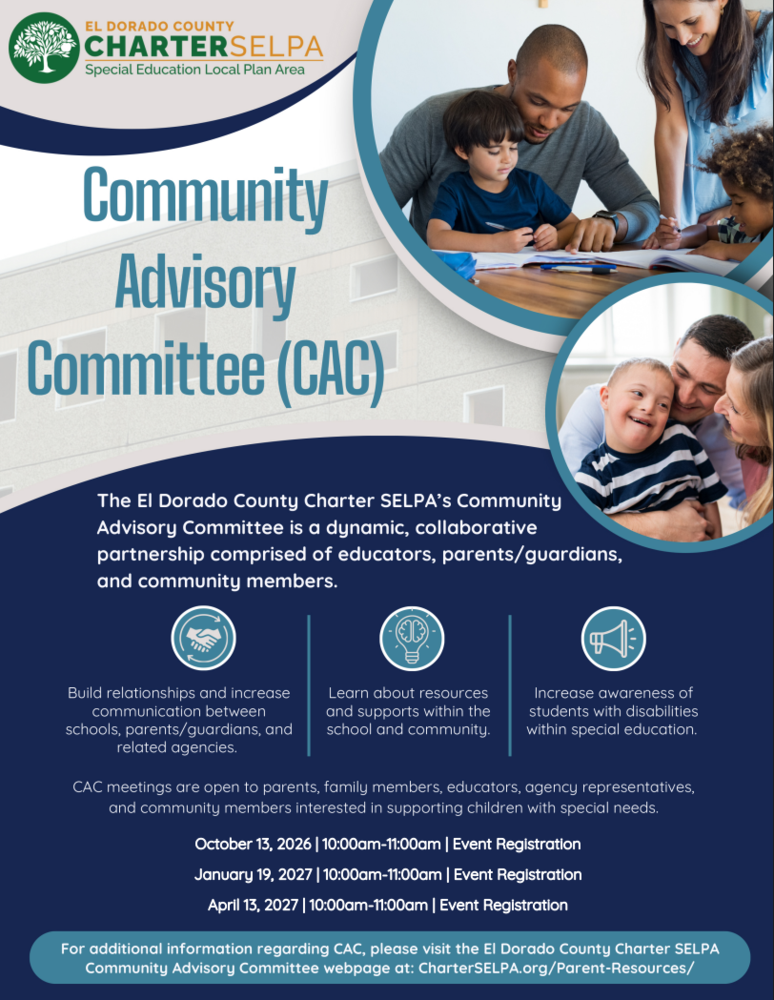
El Dorado County Charter SELPA’s Community Advisory Committee (CAC) is a group formed to advise the Charter SELPA about the Special Education Local Plan, annual priorities, parent education, and other special education related activities. The CAC is designed to be a dynamic collaborative partnership of educators, parents, and community members.
A Pathway to Nurture Social and Emotional Well-being
This Strengthening Partnerships for Students with Disabilities webinar session focuses on the topic of Purpose: A Pathway to Nurture Social and Emotional Well-being. The mix of ease and hardship in our work and in our lives requires that we, as parents or practitioners, are nurtured, too. Our social and emotional well-being is intricately connected to our ability to support the well-being of the parents or children we work with and care for. This presentation offers practitioners that work with parents, practical science-based lessons and activities to help you prioritize cultivating an important key to your social and emotional well-being: a sense of purpose. Additionally, we’ll cover related insights and practices from research about a sense of purpose for parents and families to foster their social and emotional well-being. Featured presenter: Maryam Abdullah, Ph.D., Parenting Program Director, Greater Good Science Center, University of California, Berkeley.